EditorialCreativeSportKollektionenVideos
Preise
0Anmelden

Visuelle Inhalte für Profis.
800 Mio.+ Bilder und Videos.

Content-Hub

  • Aktuelle Ereignisse
  • Bilder des Jahres
  • Sport
  • Editorial
  • Creative
  • Kollektionen
  • Videos

Angebote

  • Preise & Pakete
  • Aktionen
  • Enterprise
  • Newsletter
  • Blog
  • The Game Magazine

Services

  • Bildrecherche
  • Auftragsfotografie
  • API & FTP Push
  • my-picturemaxx
  • Partner werden

Unternehmen

  • Über IMAGO
  • Karriere
  • News

Hilfe-Center

  • FAQ
  • Kontakt
ImpressumNutzungsbedingungenLizenzinformationenDatenschutzDatenschutzeinstellungen
© 2026 IMAGO
CEPICBAPLABVPA
Zurück zu den Kollektionen

IMAGO History, Archiv, Raumfahrt, USA, Rakete Little Joe 1959-1966

20.11.2025

Die folgenden Fotos wurden von der IMAGO Bildredaktion zu diesem Thema für Sie ausgewählt. Für weitere Bilder nutzen Sie bitte die Suchfunktion.
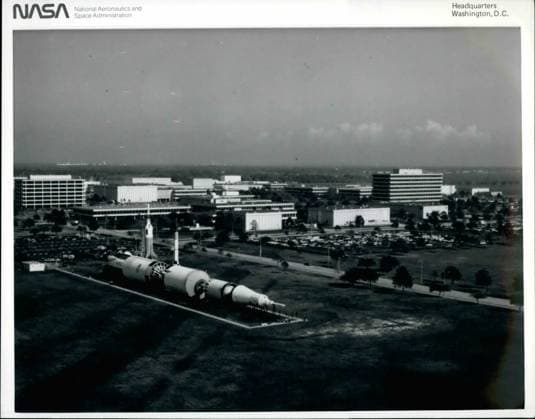
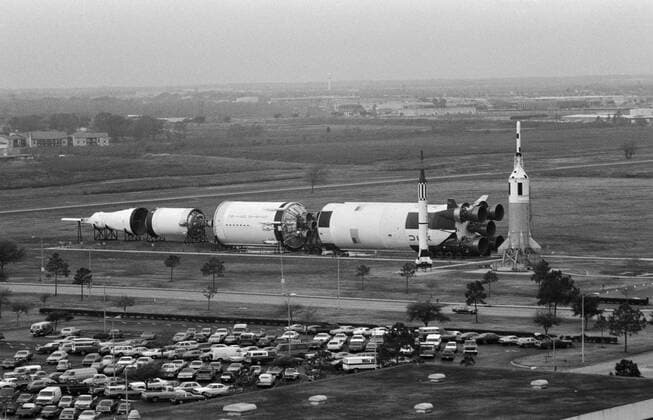
  • Astronaut Kometen NASA Weltraum Raumschiff UFOs 1982 – Johnson Space Center, Houston, Texas. JSC-Luftaufnahme – Diese nordöstliche Ansicht des Johnson Space Center wurde im Dezember 1982 von einem Fotografen an Bord eines tieffliegenden NASA-Flugzeugs aufgenommen. Viele der Einrichtungen im zentralen Bereich des NASA-Zentrums in Houston sind zu erkennen. Im Vordergrund sind eine Saturn-V-Trägerrakete sowie Modelle einer Mercury-Redstone- und einer Little-Joe-Rakete zu sehen. Die fensterlose Anlage, das zweite Gebäude von links in der Bildmitte, ist das Missionskontrollzentrum. Das neunstöckige Gebäude rechts in der Mitte ist die Projektmanagement-Einrichtung. Das Ufer des Clear Lake ist oben rechts teilweise sichtbar. *** Astr  Copyright: xUnitedxArchivesx xkpaxKeystonex 19600108_baf_k09_1273
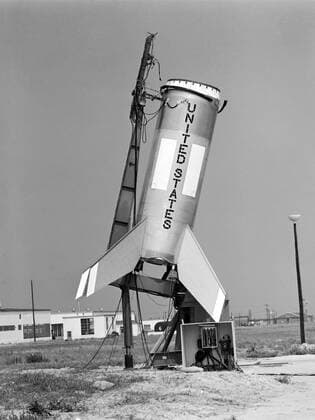
  • RECORD DATE NOT STATED Little Joe 5B High-Q-Abort Test, 1961. Creator: NASA. Copyright:xmare,paracadute,spazio,esplorazione,geografia,secolo,concetto,navexspaziale,B&W,esplorazionexdelloxspazio,corsaxdixspazio,NASA,Annixsessanta,nerox&xbianco,neroxexbianco,B W,glixannix60,ventesimoxsecolo,photograph,NationalxAeronauticsxandxSpacexAdministration,NASA,NationalxAeronauticsxandxSpacexAdministration,Spaceflight,HeritagexSpace,MercuryxProjectx IMAGO ,2860588 ! ACHTUNG: AUFNAHMEDATUM GESCHÄTZT!  Copyright:mare,paracadute,spazio,esplorazione,geografia,secolo,concetto,navexspaziale,B&W,esplorazionexdelloxspazio,corsaxdixspazio,NASA,Annixsessanta,nerox&xbianco,neroxexbianco,B W,glixannix60,vente
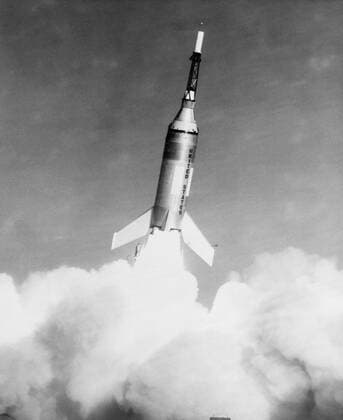
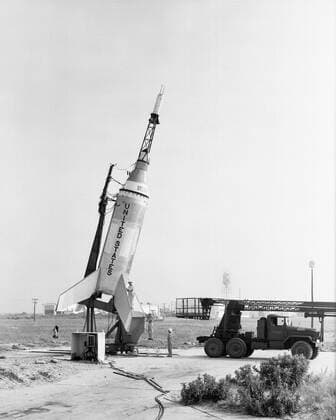
  • The launch of the Little Joe booster for the LJ1B mission on the launch pad from the wallops Flight Facility, Wallops Island, Virginia, on January 21, 1960. This mission achieved the suborbital Mercury capsule test, testing of the escape system, and biomedical tests by using a monkey, named Miss Sam. Copyright: xpiemagsx piemagsspace-160666 !ACHTUNG AUFNAHMEDATUM GESCHÄTZT!
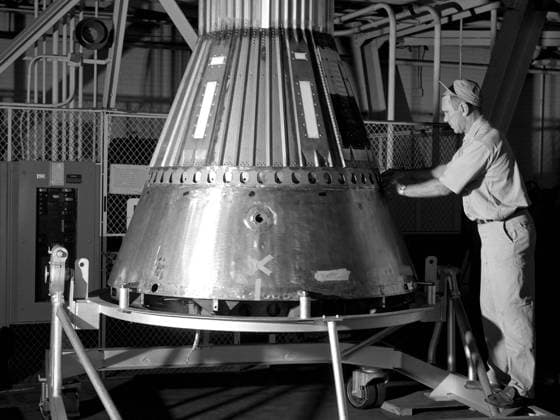
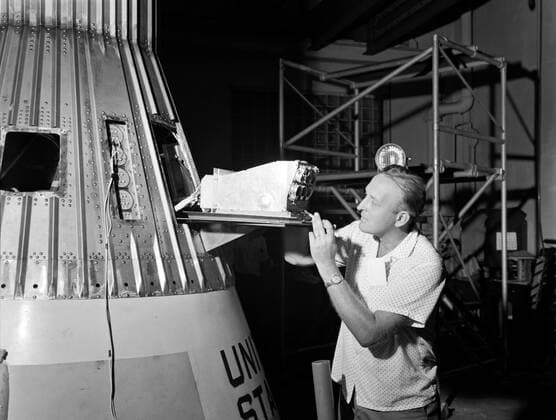
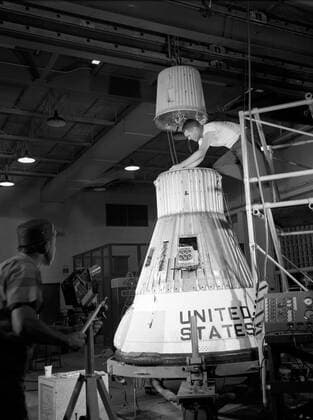
  • A NASA mechanic secures the afterbody to a Mercury capsule in the hangar at the Lewis Research Center. The capsule was one of two built at Lewis for the Big Joe launches scheduled for September 1959. The initial phase of Project Mercury consisted of a series of unmanned launches using the Air Force™s Redstone and Atlas boosters and the Langley-designed Little Joe boosters. The first Atlas launch, referred to as Big Joe, was a single attempt early in Project Mercury to use a full-scale Atlas booster to simulate the reentry of a mock-up Mercury capsule without actually placing it in orbit. The overall design of Big Joe had been completed by December 1958, and soon thereafter project manager Aleck Bond assigned NASA Lewis the tas Copyright: xpiemagsx piemagsspace-160016 !ACHTUNG AUFNAHMEDATUM GESCHÄTZT!
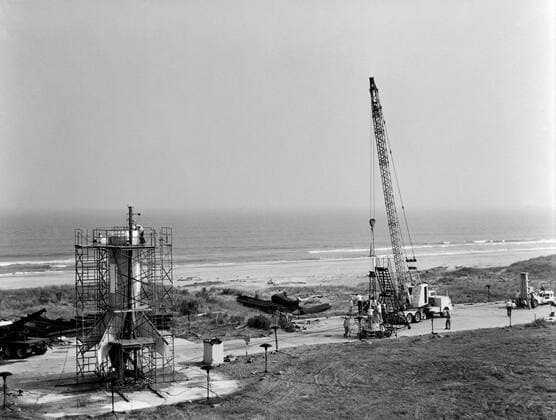
  • The Little Joe launch vehicle for the LJ1 mission on the launch pad at the wallops Flight Facility, Wallops Island, Virginia, on January 21, 1960. This mission achieved the suborbital Mercury cupsule test, testing of the escape system, and biomedical tests by using a monkey, named Miss Sam. Copyright: xpiemagsx piemagsspace-158959 !ACHTUNG AUFNAHMEDATUM GESCHÄTZT!
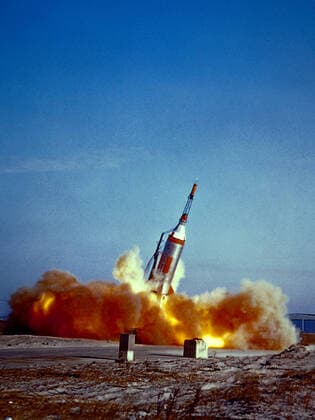
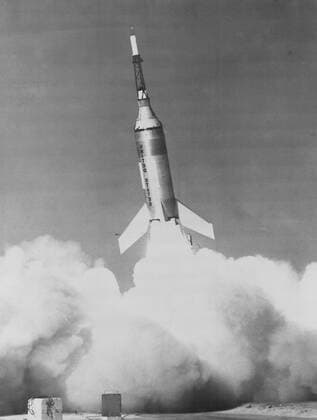
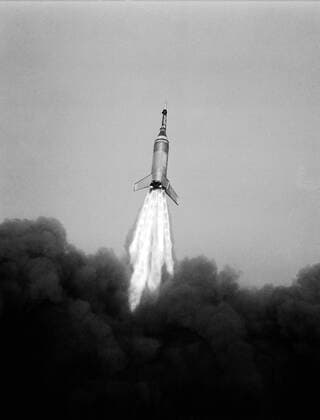
  • G61-00030 (4 Nov. 1959) --- Launch of Little Joe-2 from Wallops Island carrying Mercury spacecraft test article. The suborbital test flight of the Mercury capsule was to test the escape system. Vehicle functioned perfectly, but escape rocket ignited several seconds too late. Copyright: xpiemagsx piemagsspace-43892 !ACHTUNG AUFNAHMEDATUM GESCHÄTZT!
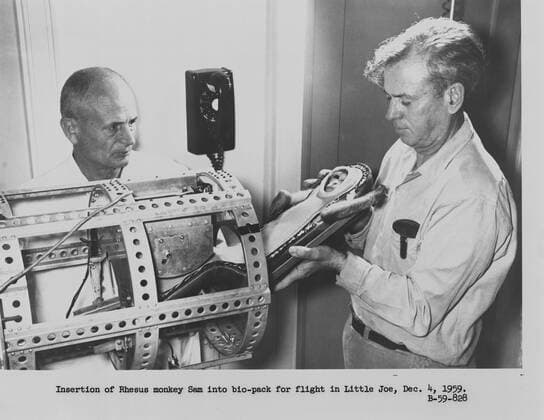
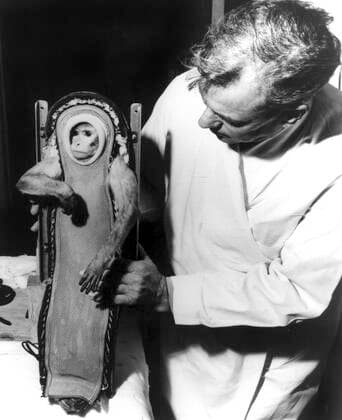
  • B59-00828 (21 Jan. 1959) --- The test subject, a rhesus monkey named Miss Sam, is seen encased in a model of the Mercury fiberglass contour couch. She is being placed in a container for the Little Joe 1B suborbital test flight of the Mercury Capsule. Copyright: xpiemagsx piemagsspace-40330 !ACHTUNG AUFNAHMEDATUM GESCHÄTZT!
  • Overall view at JSC lookin west from atop of Bldg. 1 showing rockets, parking lot and all threee stages of Saturn V. first stage of Saturn V exhibit in Rocket Park on west side of center little joe and mercury models are seen 1. JSC- Aerials Copyright: xpiemagsx piemagsspace-2178 !ACHTUNG AUFNAHMEDATUM GESCHÄTZT!
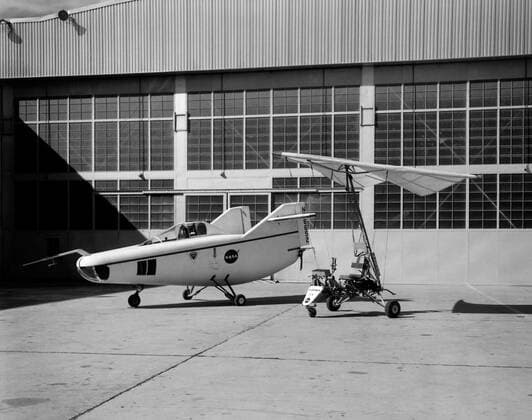
  • In this photo of the M2-F1 lifting body and the Paresev 1B on the ramp, the viewer sees two vehicles representing different approaches to building a research craft to simulate a spacecraft able to land on the ground instead of splashing down in the ocean as the Mercury capsules did. The M2-F1 was a lifting body, a shape able to re-enter from orbit and land. The Paresev (Paraglider Research Vehicle) used a Rogallo wing that could be (but never was) used to replace a conventional parachute for landing a capsule-type spacecraft, allowing it to make a controlled landing on the ground. Copyright: xpiemagsx piemagsspace-1137 !ACHTUNG AUFNAHMEDATUM GESCHÄTZT!
  • S61-01673 (23 April 1961) --- View of the mating of Little Joe-5B launch vehicle with Mercury capsule 14. Copyright: xpiemagsx piemagsspace-850 !ACHTUNG AUFNAHMEDATUM GESCHÄTZT!
  • S61-01663 (23 April 1961) --- View of the mating of Little Joe-5B launch vehicle with Mercury capsule 14. Copyright: xpiemagsx piemagsspace-849 !ACHTUNG AUFNAHMEDATUM GESCHÄTZT!
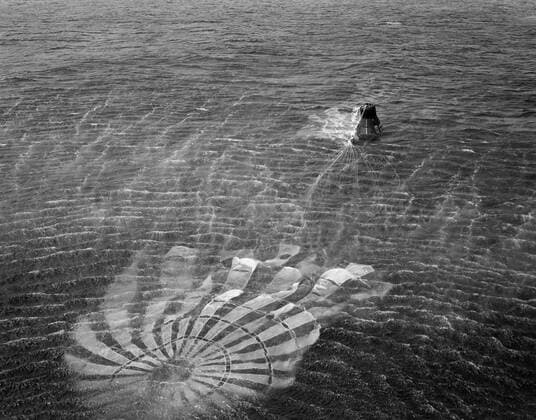
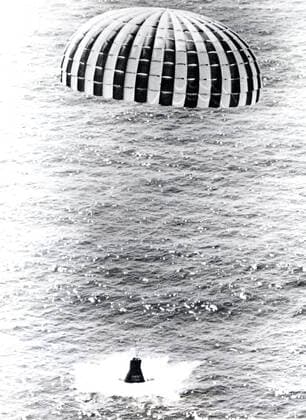
  • S61-01398 (18 March 1961) --- View of the recovery of the Little Joe-5A spacecraft which lifted off on March 18, 1961 from Wallops Island. The photo was taken from the recovery helicopter and shows the craft s parachute still attached and floating in the water next to the capsule. Little Joe-5A was a suborbital flight to test the Mercury capsule. The escape rocket motor fired prematurely and prior to capsule release. Copyright: xpiemagsx piemagsspace-839 !ACHTUNG AUFNAHMEDATUM GESCHÄTZT!
  • B60-00364 (4 Nov. 1959) --- Launch of Little Joe-2 from Wallops Island carrying Mercury spacecraft test article. The suborbital test flight of the Mercury capsule was to test the escape system. Vehicle functioned perfectly, but escape rocket ignited several seconds too late. Copyright: xpiemagsx piemagsspace-731 !ACHTUNG AUFNAHMEDATUM GESCHÄTZT!
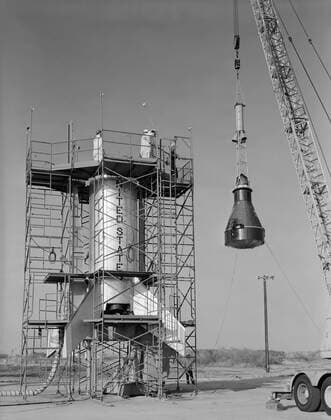
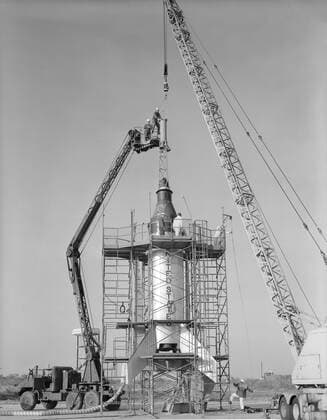
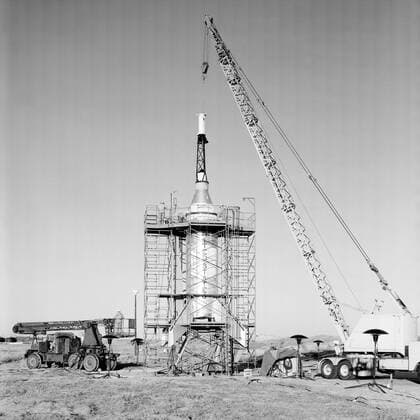
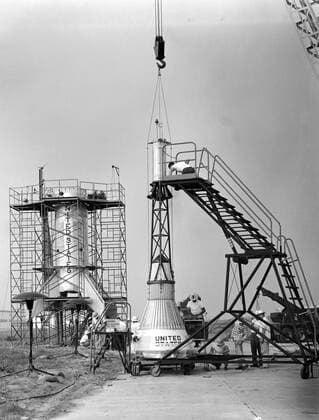
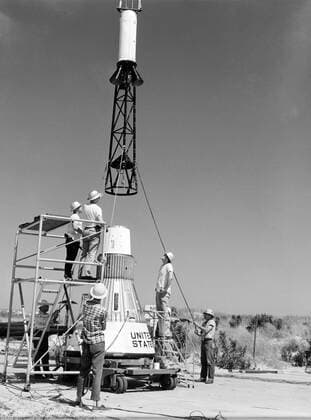
  • The Mercury capsule and escape tower are being lowered onto the Little Joe booster for launch on August 21, 1959. Joseph Shortal described this as follows (vol. 3, p. 33): The Little Joe booster was assembled at Wallops on its special launcher in a vertical attitude. It is shown in the on the left with the work platform in place. The launcher was located on a special concrete slab in Launching Area 1. The capsule was lowered onto the booster by crane.... After the assembly was completed, the scaffolding was disassembled and the launcher pitched over to its normal launch angle of 80 degrees.... Little Joe had a diameter of 80 inches and an overall length, including the capsule and escape tower of 48 feet. The total weight at launch was ab Copyright: xpiemagsx piemagsspace-710 !ACHTUNG AUFNAHMEDATUM GESCHÄTZT!
  • The Mercury capsule and escape tower are being lowered onto the Little Joe booster for launch on August 21, 1959. Joseph Shortal described this as follows (vol. 3, p. 33): The Little Joe booster was assembled at Wallops on its special launcher in a vertical attitude. It is shown in the on the left with the work platform in place. The launcher was located on a special concrete slab in Launching Area 1. The capsule was lowered onto the booster by crane.... After the assembly was completed, the scaffolding was disassembled and the launcher pitched over to its normal launch angle of 80 degrees.... Little Joe had a diameter of 80 inches and an overall length, including the capsule and escape tower of 48 feet. The total weight at launch was ab Copyright: xpiemagsx piemagsspace-709 !ACHTUNG AUFNAHMEDATUM GESCHÄTZT!
  • Launching of the LJ6 Little Joe on Oct. 4, 1959 took place at Wallops Island, Va. This was the first attempt to launch an instrumented capsule with a Little Joe booster. Only the LJ1A and the LJ6 used the space metal chevron plates as heat reflector shields, as they kept shattering. Caption title ...and ascending skyward on a plume of exhaust. Photograph published in Winds of Change, 75th Anniversary NASA publication, page 77, by James Schultz Copyright: xpiemagsx piemagsspace-700 !ACHTUNG AUFNAHMEDATUM GESCHÄTZT!
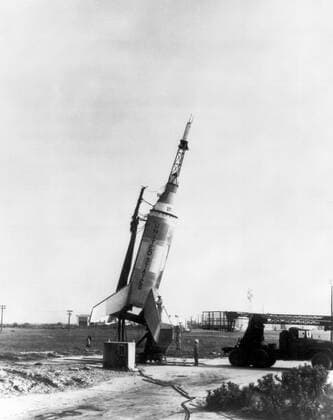
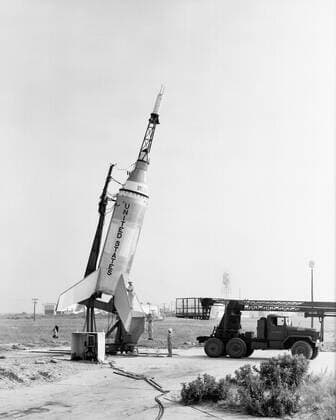
  • Little Joe on launcher at Wallops Island. Copyright: xpiemagsx piemagsspace-686 !ACHTUNG AUFNAHMEDATUM GESCHÄTZT!
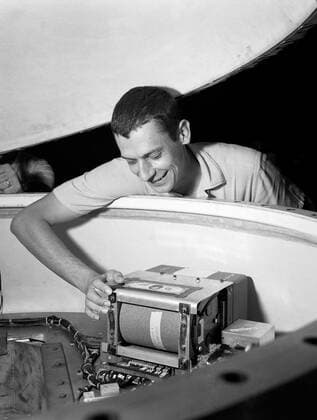
  • Technicians adjust the rocket motor during the attachment of the escape tower to the Mercury capsule prior to assembly with Little Joe launcher, August 20, 1959. Joseph Shortal wrote (vol. 3., p. 33): The escape tower and rocket motors were taken from the Mercury capsule production. The tower is shown being attached to the capsule.... The escape rocket was a Grand Central 1-KS-52000 motor with three canted nozzles. The tower-jettison motor was an Atlantic Research Corp. 1.4-KS-785 motor. This was the same design tested in a beach abort test...and had the offset thrust line as used in the beach abort test to insure that the capsule would get away from the booster in an emergency. The escape system weighed 1,015 pounds, including 236 pounds Copyright: xpiemagsx piemagsspace-682 !ACHTUNG AUFNAHMEDATUM GESCHÄTZT!
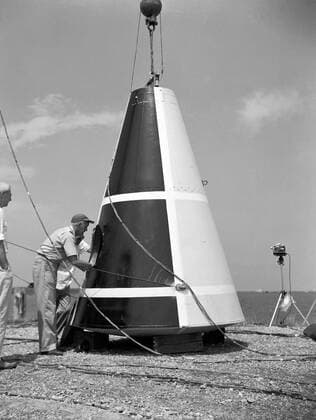
  • Technicians adjust the rocket motor during the attachment of the escape tower to the Mercury capsule prior to assembly with Little Joe launcher, August 20, 1959. Joseph Shortal wrote (vol. 3., p. 33): The escape tower and rocket motors were taken from the Mercury capsule production. The tower is shown being attached to the capsule.... The escape rocket was a Grand Central 1-KS-52000 motor with three canted nozzles. The tower-jettison motor was an Atlantic Research Corp. 1.4-KS-785 motor. This was the same design tested in a beach abort test...and had the offset thrust line as used in the beach abort test to insure that the capsule would get away from the booster in an emergency. The escape system weighed 1,015 pounds, including 236 pounds Copyright: xpiemagsx piemagsspace-681 !ACHTUNG AUFNAHMEDATUM GESCHÄTZT!
  • Technicians adjust the rocket motor during the attachment of the escape tower to the Mercury capsule prior to assembly with Little Joe launcher, August 20, 1959. Joseph Shortal wrote (vol. 3., p. 33): The escape tower and rocket motors were taken from the Mercury capsule production. The tower is shown being attached to the capsule.... The escape rocket was a Grand Central 1-KS-52000 motor with three canted nozzles. The tower-jettison motor was an Atlantic Research Corp. 1.4-KS-785 motor. This was the same design tested in a beach abort test...and had the offset thrust line as used in the beach abort test to insure that the capsule would get away from the booster in an emergency. The escape system weighed 1,015 pounds, including 236 pounds Copyright: xpiemagsx piemagsspace-680 !ACHTUNG AUFNAHMEDATUM GESCHÄTZT!
  • Technicians adjust the rocket motor during the attachment of the escape tower to the Mercury capsule prior to assembly with Little Joe launcher, August 20, 1959. Joseph Shortal wrote (vol. 3., p. 33): The escape tower and rocket motors were taken from the Mercury capsule production. The tower is shown being attached to the capsule.... The escape rocket was a Grand Central 1-KS-52000 motor with three canted nozzles. The tower-jettison motor was an Atlantic Research Corp. 1.4-KS-785 motor. This was the same design tested in a beach abort test...and had the offset thrust line as used in the beach abort test to insure that the capsule would get away from the booster in an emergency. The escape system weighed 1,015 pounds, including 236 pounds Copyright: xpiemagsx piemagsspace-679 !ACHTUNG AUFNAHMEDATUM GESCHÄTZT!
  • Technicians adjust the rocket motor during the attachment of the escape tower to the Mercury capsule prior to assembly with Little Joe launcher, August 20, 1959. Joseph Shortal wrote (vol. 3., p. 33): The escape tower and rocket motors were taken from the Mercury capsule production. The tower is shown being attached to the capsule.... The escape rocket was a Grand Central 1-KS-52000 motor with three canted nozzles. The tower-jettison motor was an Atlantic Research Corp. 1.4-KS-785 motor. This was the same design tested in a beach abort test...and had the offset thrust line as used in the beach abort test to insure that the capsule would get away from the booster in an emergency. The escape system weighed 1,015 pounds, including 236 pounds Copyright: xpiemagsx piemagsspace-678 !ACHTUNG AUFNAHMEDATUM GESCHÄTZT!
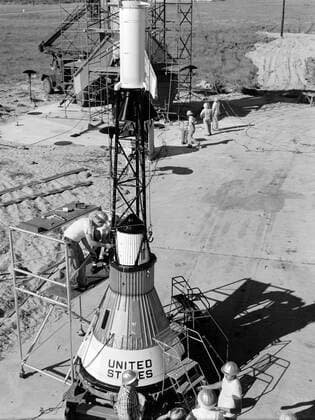
  • Technicians attach the escape tower to the Mercury capsule prior to assembly with Little Joe launcher, August 20, 1959. Joseph Shortal describe this as follows (vol. 3., p. 33): The escape tower and rocket motors were taken from the Mercury capsule production. The tower is shown being attached to the capsule.... The escape rocket was a Grand Central 1-KS-52000 motor with three canted nozzles. The tower-jettison motor was an Atlantic Research Corp. 1.4-KS-785 motor. This was the same design tested in a beach abort test...and had the offset thrust line as used in the beach abort test to insure that the capsule would get away from the booster in an emergency. The escape system weighed 1,015 pounds, including 236 pounds of ballast for stabili Copyright: xpiemagsx piemagsspace-677 !ACHTUNG AUFNAHMEDATUM GESCHÄTZT!
  • Technicians attach the escape tower to the Mercury capsule prior to assembly with Little Joe launcher, August 20, 1959. Joseph Shortal describe this as follows (vol. 3., p. 33): The escape tower and rocket motors were taken from the Mercury capsule production. The tower is shown being attached to the capsule.... The escape rocket was a Grand Central 1-KS-52000 motor with three canted nozzles. The tower-jettison motor was an Atlantic Research Corp. 1.4-KS-785 motor. This was the same design tested in a beach abort test...and had the offset thrust line as used in the beach abort test to insure that the capsule would get away from the booster in an emergency. The escape system weighed 1,015 pounds, including 236 pounds of ballast for stabili Copyright: xpiemagsx piemagsspace-676 !ACHTUNG AUFNAHMEDATUM GESCHÄTZT!
  • Technicians attach the escape tower to the Mercury capsule prior to assembly with Little Joe launcher, August 20, 1959. Joseph Shortal describe this as follows (vol. 3., p. 33): The escape tower and rocket motors were taken from the Mercury capsule production. The tower is shown being attached to the capsule.... The escape rocket was a Grand Central 1-KS-52000 motor with three canted nozzles. The tower-jettison motor was an Atlantic Research Corp. 1.4-KS-785 motor. This was the same design tested in a beach abort test...and had the offset thrust line as used in the beach abort test to insure that the capsule would get away from the booster in an emergency. The escape system weighed 1,015 pounds, including 236 pounds of ballast for stabili Copyright: xpiemagsx piemagsspace-675 !ACHTUNG AUFNAHMEDATUM GESCHÄTZT!
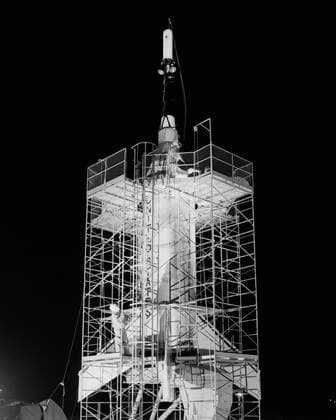
  • Testing of the Little Joe booster on its launcher. The launcher is positioned at its normal launch angle of 80 degrees. Joseph Shortal wrote (vol. 3, p. 33): The Little Joe booster was assembled at Wallops on its special launcher in a vertical attitude. It is shown in the on the left with the work platform in place. The launcher was located on a special concrete slab in Launching Area 1. The capsule was lowered onto the booster by crane.... After the assembly was completed, the scaffolding was disassembled and the launcher pitched over to its normal launch angle of 80 degrees.... Little Joe had a diameter of 80 inches and an overall length, including the capsule and escape tower of 48 feet. The total weight at launch was about 43,000 pou Copyright: xpiemagsx piemagsspace-670 !ACHTUNG AUFNAHMEDATUM GESCHÄTZT!
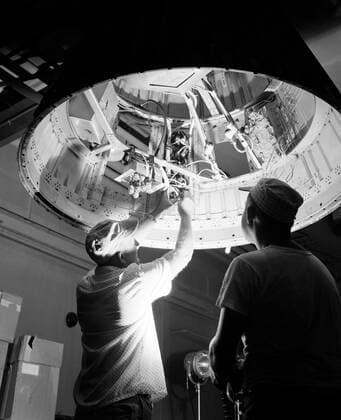
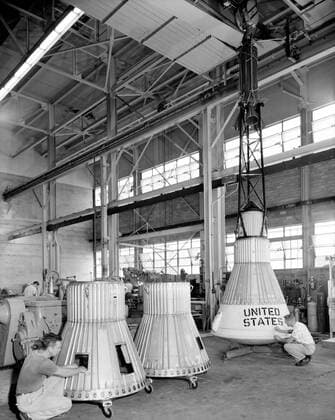
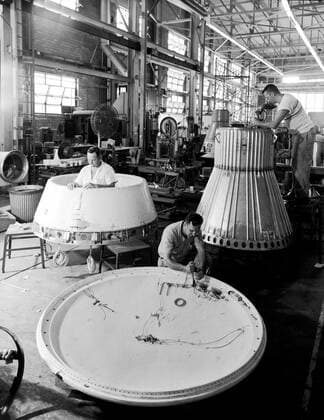
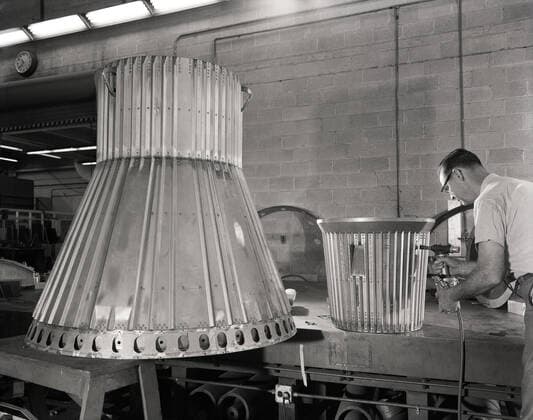
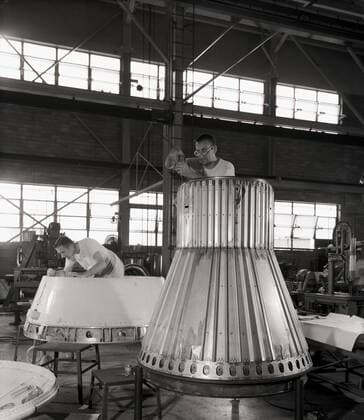
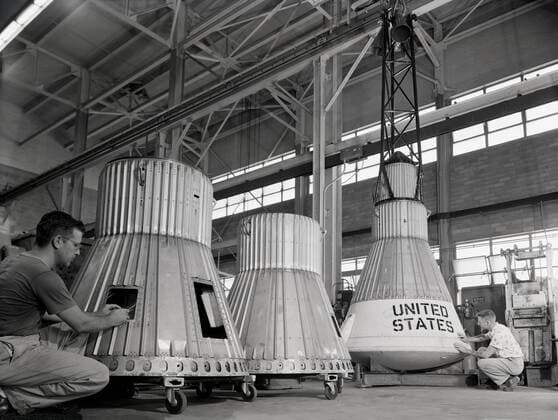
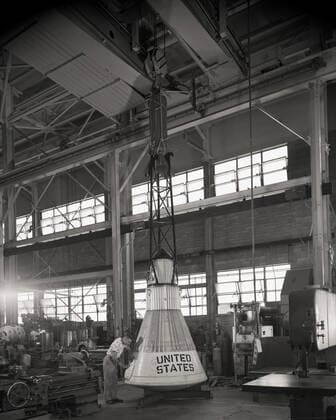
  • Assembling the Little Joe capsules. The capsules were manufactured in-house by Langley technicians. Three capsules are shown here in various stages of assembly. The escape tower and rocket motors shown on the completed capsule would be removed before shipping and finally assembly for launching at Wallops Island. Joseph Shortal wrote (vol. 3, p. 32): Design of the Little Joe capsules began at Langley before McDonnell started on the design of the Mercury capsule and was, therefore, a separate design. Although it was not designed to carry a man, it did have to carry a monkey. It had to meet the weight and center of gravity requirements of Mercury and withstand the same aerodynamic loads during the exit trajectory. Although in comparison Copyright: xpiemagsx piemagsspace-664 !ACHTUNG AUFNAHMEDATUM GESCHÄTZT!
  • Assembling the Little Joe capsules. The capsules were manufactured in-house by Langley technicians. Three capsules are shown here in various stages of assembly. The escape tower and rocket motors shown on the completed capsule would be removed before shipping and finally assembly for launching at Wallops Island. Joseph Shortal wrote (vol. 3, p. 32): Design of the Little Joe capsules began at Langley before McDonnell started on the design of the Mercury capsule and was, therefore, a separate design. Although it was not designed to carry a man, it did have to carry a monkey. It had to meet the weight and center of gravity requirements of Mercury and withstand the same aerodynamic loads during the exit trajectory. Although in comparison Copyright: xpiemagsx piemagsspace-663 !ACHTUNG AUFNAHMEDATUM GESCHÄTZT!
  • Assembling the Little Joe capsules. The capsules were manufactured in-house by Langley technicians. Three capsules are shown here in various stages of assembly. The escape tower and rocket motors shown on the completed capsule would be removed before shipping and finally assembly for launching at Wallops Island. Joseph Shortal wrote (vol. 3, p. 32): Design of the Little Joe capsules began at Langley before McDonnell started on the design of the Mercury capsule and was, therefore, a separate design. Although it was not designed to carry a man, it did have to carry a monkey. It had to meet the weight and center of gravity requirements of Mercury and withstand the same aerodynamic loads during the exit trajectory. Although in comparison Copyright: xpiemagsx piemagsspace-662 !ACHTUNG AUFNAHMEDATUM GESCHÄTZT!
  • Assembling the Little Joe capsules. The capsules were manufactured in-house by Langley technicians. Three capsules are shown here in various stages of assembly. The escape tower and rocket motors shown on the completed capsule would be removed before shipping and finally assembly for launching at Wallops Island. Joseph Shortal wrote (vol. 3, p. 32): Design of the Little Joe capsules began at Langley before McDonnell started on the design of the Mercury capsule and was, therefore, a separate design. Although it was not designed to carry a man, it did have to carry a monkey. It had to meet the weight and center of gravity requirements of Mercury and withstand the same aerodynamic loads during the exit trajectory. Although in comparison Copyright: xpiemagsx piemagsspace-661 !ACHTUNG AUFNAHMEDATUM GESCHÄTZT!
  • Assembling the Little Joe capsules. The capsules were manufactured in-house by Langley technicians. Three capsules are shown here in various stages of assembly. The escape tower and rocket motors shown on the completed capsule would be removed before shipping and finally assembly for launching at Wallops Island. Joseph Shortal wrote (vol. 3, p. 32): Design of the Little Joe capsules began at Langley before McDonnell started on the design of the Mercury capsule and was, therefore, a separate design. Although it was not designed to carry a man, it did have to carry a monkey. It had to meet the weight and center of gravity requirements of Mercury and withstand the same aerodynamic loads during the exit trajectory. Although in comparison Copyright: xpiemagsx piemagsspace-660 !ACHTUNG AUFNAHMEDATUM GESCHÄTZT!
  • Assembling the Little Joe capsules. The capsules were manufactured in-house by Langley technicians. Three capsules are shown here in various stages of assembly. The escape tower and rocket motors shown on the completed capsule would be removed before shipping and finally assembly for launching at Wallops Island. Joseph Shortal wrote (vol. 3, p. 32): Design of the Little Joe capsules began at Langley before McDonnell started on the design of the Mercury capsule and was, therefore, a separate design. Although it was not designed to carry a man, it did have to carry a monkey. It had to meet the weight and center of gravity requirements of Mercury and withstand the same aerodynamic loads during the exit trajectory. Although in comparison Copyright: xpiemagsx piemagsspace-659 !ACHTUNG AUFNAHMEDATUM GESCHÄTZT!
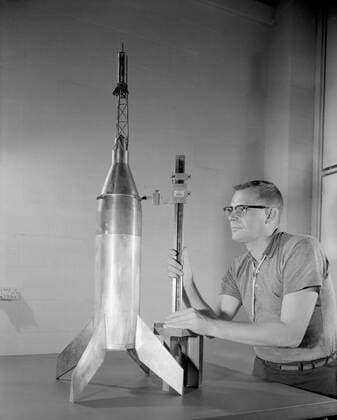
  • Publicity photograph of a technician measuring a wind tunnel model of the Little Joe test vehicle. Joseph Shortal noted that (vol. 3, p. 29): The largest project at Wallops in support of Mercury was the Little Joe project, designed to qualify the abort-escape system under flight conditions. James Hansen (p. 47) writes: STG engineers Max Faget and Paul Purser, then of Langley s PARD, had conceived Little Joe as a space capsule test vehicle even before the establishment of NASA and the formation of the STG. Girlruth understood the importance of the Little Joe tests: We had to be sure there were no serious performance and operational problems that we had simply not thought of in such a new and radical type of flight vehicle. -- Published Copyright: xpiemagsx piemagsspace-648 !ACHTUNG AUFNAHMEDATUM GESCHÄTZT!
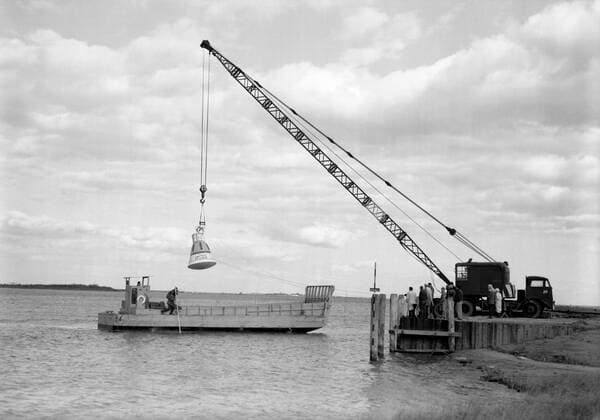
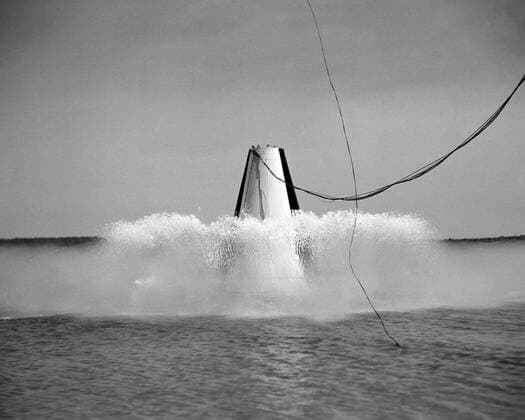
  • Water drop and recovery from shore-based crane at Langley s back river. Copyright: xpiemagsx piemagsspace-597 !ACHTUNG AUFNAHMEDATUM GESCHÄTZT!
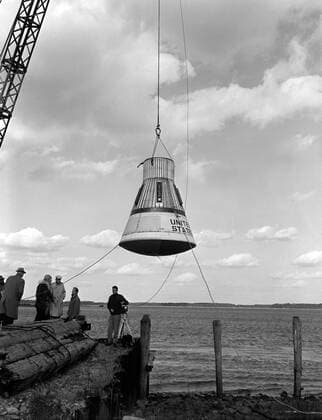
  • Water drop and recovery from shore-based crane at Langley s back river. Copyright: xpiemagsx piemagsspace-596 !ACHTUNG AUFNAHMEDATUM GESCHÄTZT!
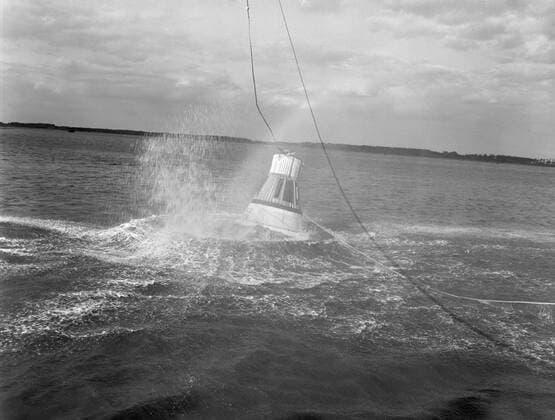
  • Water drop and recovery from shore-based crane at Langley s back river. Copyright: xpiemagsx piemagsspace-594 !ACHTUNG AUFNAHMEDATUM GESCHÄTZT!
  • Photographed on: 08 05 1958. -- Impact test conducted by Langley s Hydrodynamics Division. The Division conducted a series of impact studies with full scale and model capsules of the original capsule shape A. Joseph Shortal wrote (Vol. 3, p. 16): The basic design of the capsule was made by M.A. Faget and his coworkers at PARD during the winter of 1957-1958. It was natural, then, that extensive use was made of the facilities at Wallops during the development of the spacecraft. The tests at Wallops consisted of 26 full-size capsules, either launched from the ground by rocket power or dropped from airplanes at high altitude and 28 scaled models, either rocket boosted or released from balloons. Emphasis in the Wallops program was on dynamic st Copyright: xpiemagsx piemagsspace-530 !ACHTUNG AUFNAHMEDATUM GESCHÄTZT!
  • Photographed on: 08 05 1958. -- Impact test conducted by Langley s Hydrodynamics Division. The Division conducted a series of impact studies with full scale and model capsules of the original capsule shape A. Joseph Shortal wrote (Vol. 3, p. 16): The basic design of the capsule was made by M.A. Faget and his coworkers at PARD during the winter of 1957-1958. It was natural, then, that extensive use was made of the facilities at Wallops during the development of the spacecraft. The tests at Wallops consisted of 26 full-size capsules, either launched from the ground by rocket power or dropped from airplanes at high altitude and 28 scaled models, either rocket boosted or released from balloons. Emphasis in the Wallops program was on dynamic st Copyright: xpiemagsx piemagsspace-520 !ACHTUNG AUFNAHMEDATUM GESCHÄTZT!
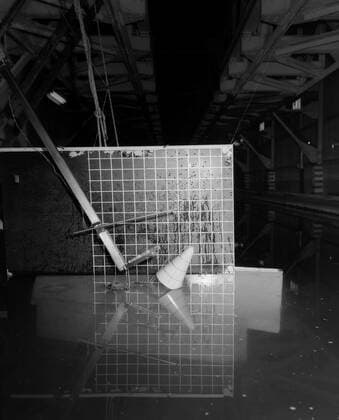
  • Testing of Mercury Capsule Shape A by the Hydrodynamics Division of Langley. Joseph Shortal wrote (vol. 3, p. 19): The Hydrodynamics Division provided assistance in determining landing loads. In this connection, after PARD engineers had unofficially approached that division to make some water impact tests with the boilerplate capsule, J.B. Parkinson, Hydrodynamics Chief visited Shortal to find out if the request had his support. Finding out that it did, Parkinson said, Its your capsule. If you want us to drop it in the water, we will do it. From Shortal (Vol. 3, p. 16): The basic design of the capsule was made by M.A. Faget and his coworkers at PARD during the winter of 1957-1958. It was natural, then, that extensive use was made of the Copyright: xpiemagsx piemagsspace-514 !ACHTUNG AUFNAHMEDATUM GESCHÄTZT!
  • Sam, the Rhesus monkey, after his ride in the Little Joe-2 (LJ-2) spacecraft. He survived a three minute Project Mercury test launch to study the effects of spaceflight and weightlessness on humans. Wallops Island, Virginia, December 04, 1959 Courtesy Everett Collection PUBLICATIONXNOTxINxCANxCHNxFRAxITAxJPNxNORxPOLxRUSxESPxUKxUSA Copyright: xCourtesyxEverettxCollectionx SCDSPAC EC002
  • August 21, 1959 - Little Joe on launcher at Wallops Island. Little Joe was a test of the escape and recovery systems on the Mercury spacecraft.  Copyright: StocktrekxImages stk203896s